
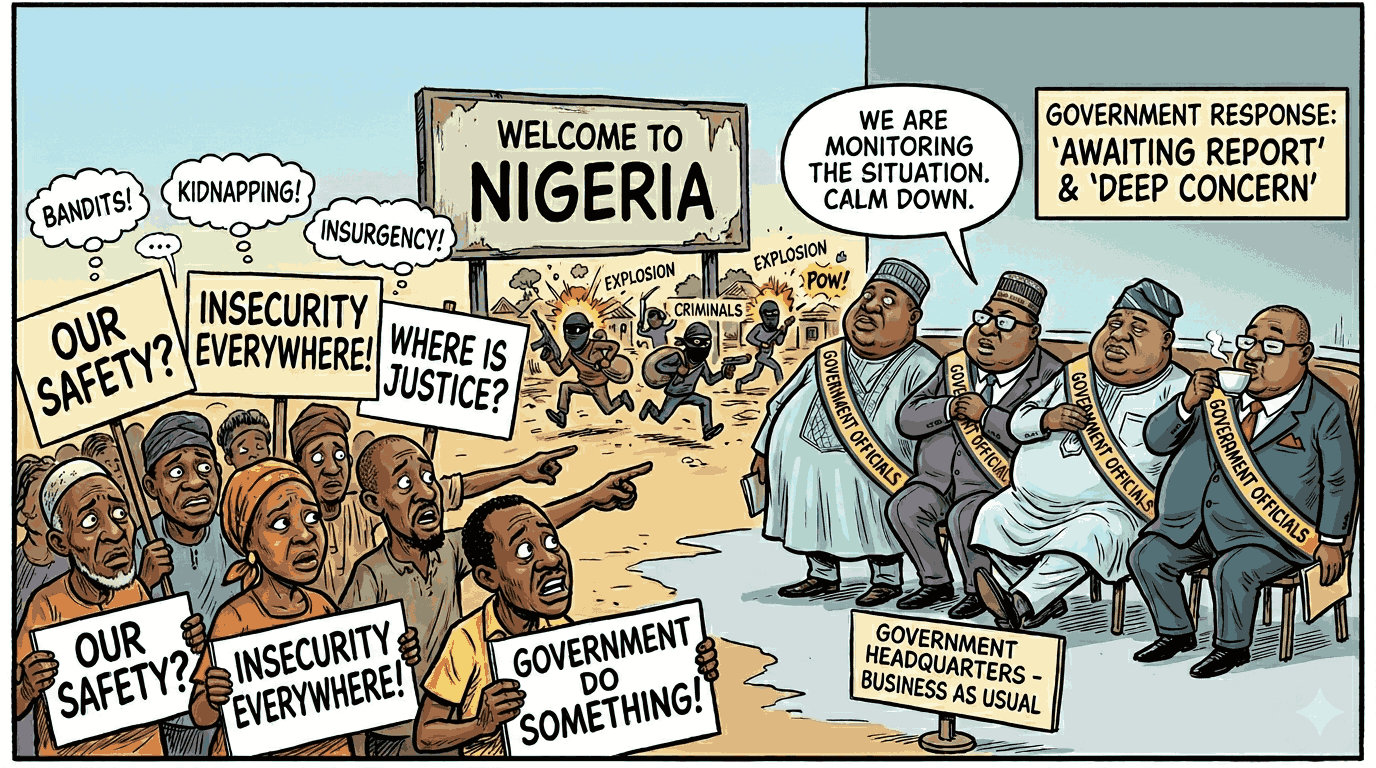
Insecurity in Nigeria: When the Government’s Response Is the Real Emergency
Terrorists graduated with certificates. Bandits got vocational training and a handshake. Citizens got a press release and a prayer. And somewhere between Jos and Yelewata, families are still digging graves. This is Nigeria’s official response to insecurity in 2026.
If insecurity in Nigeria were a fire, the government’s response would be a man standing beside the blaze with a glass of water, reading Bible verses about forgiveness. Not because he is heartless. But because he has decided, with alarming confidence, that empathy and rehabilitation are more important than stopping people from being burned alive. That is the picture Nigeria’s most senior security officials have painted in recent months. And if you are a family in Plateau State or Benue State still identifying bodies, that picture is not just insulting. It is a message.
What follows is not a hit piece on the idea of rehabilitation. In the right conditions, deradicalisation programmes work. What this is, is an honest look at the gap between what Nigeria’s leadership says about insecurity in Nigeria and what Nigerians on the ground are actually living. Because that gap, wide enough to swallow entire communities, is where the real emergency lives.
When Nigeria’s Top Military Officer Quoted the New Testament
General Olufemi Oluyede
General Oluyede is the most senior military official in Nigeria, responsible for the strategic direction of the country’s counterterrorism and national security operations. In March 2026, he stood before an audience of military officials and government representatives at the inaugural lecture of the Joint Doctrine and Warfare Centre in Abuja and delivered a statement that lit up every Nigerian social media timeline for days.
Speaking in defence of Operation Safe Corridor, the government’s programme for rehabilitating terrorists, General Oluyede offered this: “People are asking why we are not killing terrorists even if they have killed others. Well, even in the Bible, the prodigal son was given a chance, so we should give terrorists a chance to repent.”
He continued: “These are Nigerians, mostly. And it is important for us to give them that window to repent, if they want, rather than pushing them to the extreme, to say, okay, it is either we kill you, or you continue with your adventure.”
The General called terrorism an “adventure.” In Borno State, that adventure has killed over 350,000 people since 2009. The families of those people were not consulted about the word choice.
Anuoluwa Soneye, NarrivonNow, there is a serious policy debate behind this statement. Deradicalisation programmes have been used with some success in countries like Indonesia, Colombia, and parts of Europe. General Oluyede is not wrong that military force alone cannot end insurgency in Nigeria. What is remarkable is the timing and the framing. This statement was delivered during the same period that communities in Borno were burying the dead from fresh attacks, that families in Plateau State were still mourning the Palm Sunday massacre in Angwan Rukuba, and that the families of missing engineers in Ebonyi were standing outside government offices demanding to know where their loved ones went. To those communities, the prodigal son analogy was not a policy position. It was a slap.
“Giving terrorists a ‘biblical chance’ while citizens die on our soil is not mercy. It is a policy of pain.”
Nigerian social media user, X (formerly Twitter), March 2026, widely shared
744 Former Terrorists Get Certificates. Nigeria Gets Questions.
One month after the prodigal son sermon, the government made the debate concrete. On April 17, 2026, 744 former terrorists and victims of violent extremism graduated from the Federal Government’s De-radicalisation, Rehabilitation and Reintegration camp in Gombe, under the Operation Safe Corridor programme. There was a ceremony. There were speeches. There was applause.
The breakdown: 597 of the 744 came from Borno State, the epicentre of the Boko Haram insurgency. Yobe contributed 58. The rest came from 15 other states. Eight were foreign nationals from Burkina Faso, Cameroon, Chad, and Niger Republic. They had all gone through months of psychosocial support, vocational training, religious reorientation, and civic education. They are now, officially, free to return to their communities.
General Oluyede, speaking at the ceremony through his representative, said: “Nigeria is giving you a second chance; do not waste it. You are returning not just to your communities but to a responsibility to live peacefully, to contribute meaningfully and to reject all forms of violence and extremism.”
That same week, fresh bandit attacks were reported in Zamfara. Nine troops were killed in Kebbi. Communities in Niger State were still waiting for answers about the 253 schoolchildren still missing since a November 2025 abduction. This is the context inside which 744 people received graduation certificates for having once participated in terrorism in Nigeria.
To be clear: analysts who study counterterrorism have long argued that rehabilitation must be part of any sustainable peace strategy. The problem is not that Nigeria runs such a programme. The problem is that the programme runs loudly, with fanfare and press releases, while victims are denied equivalent attention, equivalent resources, and equivalent government presence. The terrorists get a graduation. The bereaved get a condolence visit at the airport.
“There has never been a regime in the history of Nigeria where terrorists who killed thousands are being rehabilitated and reintegrated into society without any visible accountability for the victims.”
@Young_insp, X (formerly Twitter), April 2026, in response to the 744 graduation
Other Memorable Things Nigeria’s Officials Have Said About Insecurity
The prodigal son sermon and the graduation ceremony are not isolated events. They sit inside a long tradition of remarkable statements from Nigeria’s security leadership on the subject of banditry in Nigeria and related crises. A brief tour:
Kayode Adeolu Egbetokun
In 2023, IG Egbetokun told the government that Nigeria needs at least 190,000 additional police officers to adequately address the country’s security needs. Nigeria at the time had roughly 371,000 officers, more than 100,000 of whom were reportedly assigned to protect politicians, VIPs, and government officials rather than ordinary citizens. In other words, more than a quarter of Nigeria’s police force was functioning as a private security detail for powerful people, while communities were left unprotected from banditry, kidnapping, and communal violence. The number 190,000 was cited by the government in November 2025 when President Tinubu declared a national security emergency, yet the police VIP guard culture that created the gap had been allowed to run unchallenged for years before the declaration.
Bola Ahmed Tinubu
In November 2025, following a wave of mass kidnappings that included the abduction of over 300 students from St Mary’s Catholic School in Niger State, President Tinubu declared a national security emergency. He ordered the police to recruit 20,000 new officers, the army to expand its personnel, and VIP police bodyguards to be redeployed to active combat zones. He said: “The safety of a nation cannot be outsourced to uniforms alone. I call on all Nigerians, community leaders, traditional institutions, religious leaders, civil society and the private sector to work closely with us.” The declaration was important. The question many Nigerians asked afterward was: what took so long? The kidnapping crisis had been escalating for years before a single mass abduction triggered emergency language.
But perhaps the most jaw-dropping entry in this collection came not in 2026, but in 2019, from a senior army general. A statement so striking it went viral at the time, then was largely forgotten, then quietly became relevant again as Nigeria’s rehabilitation agenda grew bolder.
Major General Abdulmalik Bulama Biu
In July 2019, Major General Biu held a press briefing in Maiduguri in which he urged Boko Haram fighters to lay down their arms and surrender. His pitch for why they should do so included this unforgettable line, reported by The Punch and independently verified on Channels Television: “An ex-Boko Haram, having laid his arms and turned away from his negativity, stands to be a president of this country. He stands to aspire to any position in this country.” He added: “Why is he wasting his time when he cannot even deliver?” The statement was made in front of journalists. It was recorded. It was broadcast. And then, in the way that only Nigeria can manage, it was absorbed into the national consciousness as simply another Tuesday.
To be fair to the General, the broader message was a genuine appeal for peace. He was trying to incentivise surrender by pointing to the possibilities of civilian life. The logic, in theory, is sound. But the optics of a uniformed officer telling men who have burnt villages, kidnapped children, and killed soldiers that the presidency awaits them if they repent, while the families of those victims receive no equivalent assurance of justice, is the kind of statement that plants seeds of hopelessness in a very specific and durable way. It tells ordinary law-abiding Nigerians something quietly devastating: that in this country, the rewards for violence and the rewards for citizenship are not as different as they should be.
A general told repentant Boko Haram fighters they could become president. Nobody told the families of their victims anything at all.
Anuoluwa Soneye, NarrivonWhat if This Is Not Incompetence? What if It Is the Plan?
Here is the most uncomfortable question this article will raise. A question that is not an accusation, but a pattern observation that Nigerians are fully entitled to hold in their minds and examine openly.
When government responses to insecurity in Nigeria consistently fail to match the urgency of the situation, when the language used is soft where it should be firm, when the resources go toward rehabilitating perpetrators while victims receive condolence letters, when the declarations come only after the blood has already been spilled and the cameras are present, one of two conclusions is available. Either the government is genuinely, structurally incapable of responding effectively. Or the government has concluded that a population paralysed by grief, exhausted by fear, and numbed by repetition, is a population too tired to demand accountability.
Both conclusions are damning. But the second one is worth sitting with. Because there is a documented relationship between manufactured hopelessness and political control. A population that has stopped believing change is possible is a population that stops organizing. It stops voting with conviction. It stops showing up at town halls. It quietly accepts the situation as permanent. And a population that has accepted insecurity as permanent is a population that will not ask where the security budget went, who is profiting from the arms contracts, or why bandits who post on social media cannot be found by a government that can track a blogger in 48 hours.
“The measure of a country’s greatness is its ability to retain compassion in times of crisis.”
Thurgood Marshall, US Supreme Court Justice
For families in Yelewata, Benue State, where over 300 people were killed in a single night attack in June 2025, the government’s dominant response was a press statement and a Makurdi-based visit. For the community of Angwan Rukuba in Jos, whose Palm Sunday massacre in March 2026 produced the haunting image of a mother cradling her dead son, the president visited the airport. The airport. Not the community. Not the place where people died. The airport.
These are not accidents of protocol. They are choices. And they send a message louder than any press release: your grief is manageable. Your numbers are acceptable. Your pain is scheduled for the next condolence slot.
“The first duty of the government is to keep citizens safe and the country secure.”
Gordon Brown, former Prime Minister of the United Kingdom
Nigeria Is Not Hopeless. But Hope Requires Action.
Here is what the data, the statements, and the pattern all point to. Insecurity in Nigeria has become, for many Nigerians, not just a physical threat but a psychological one. It is the slow erosion of the belief that government can or will protect you. It is the creeping acceptance that mass kidnapping is normal, that banditry is a weather event, that terrorism is just a feature of the landscape. And when a people believe that nothing can be done, those in power can continue doing nothing.
That is the most dangerous place for a nation to arrive. Not the violence itself, terrible as it is. But the moment the violence becomes expected, unremarkable, and undemanded. The moment the graduation of 744 ex-terrorists is answered with a tired scroll past. The moment the prodigal son sermon lands without outrage. The moment we bury the dead and decide not to ask who should answer for it.
That moment is what the oppressor prepares for. It is what soft language and delayed action and airport condolence visits are designed to produce. And the antidote to it is exactly what powerful people have always feared the most: a population that refuses to stop asking questions. A population that holds names accountable. A population that shows up, not just at funerals, but at town halls, at ballot boxes, at the gates of ministries in black T-shirts, demanding to be heard before the next attack and not after it.
At Narrivon, that is what we are here for. Not to perform outrage. Not to provide a space for helplessness. But to make sure that every Nigerian who reads these pages understands something with absolute clarity: your voice is not an optional civic accessory. It is the only thing standing between the country you have and the country you deserve. The insecurity crisis in Nigeria will not be solved by the people who have allowed it to grow. It will be solved when enough citizens decide, firmly and consistently, that the status quo is no longer acceptable and that they will say so, loudly, until something changes.
Patriotism in Nigeria is not a flag or an anthem. It is the willingness to hold power accountable when power fails you. It is refusing to accept that insecurity, banditry, and insurgency are simply Nigeria’s destiny. It is demanding that the people paid to protect this country actually protect it, and facing real consequences when they do not. That is the work. That is what Narrivon is committed to supporting. And it starts with you choosing, today, not to be silent.
A government that responds to terrorism with theology and to grief with airport visits has already lost the moral argument. The only question left is whether citizens will let them lose the country too.
Anuoluwa Soneye, NarrivonFrequently Asked Questions
What did Nigeria’s Chief of Defence Staff say about terrorists?
In March 2026, General Olufemi Oluyede, Nigeria’s Chief of Defence Staff, compared terrorists to the biblical prodigal son at an Armed Forces lecture in Abuja, arguing they should be given a chance to repent rather than be eliminated. He later oversaw the April 2026 graduation of 744 former terrorists from the Operation Safe Corridor rehabilitation camp in Gombe.
What is Operation Safe Corridor in Nigeria?
Operation Safe Corridor is Nigeria’s federal government de-radicalisation, rehabilitation and reintegration programme for repentant terrorists and insurgents, established in 2016. It focuses on psychosocial support, vocational training, religious reorientation, and civic education. In April 2026, 744 former terrorists graduated from the programme in Gombe, bringing total rehabilitated insurgents to approximately 2,190.
How bad is insecurity in Nigeria in 2025 and 2026?
Nigeria’s insecurity crisis remains severe. Between July 2024 and June 2025, at least 4,722 people were kidnapped in 997 incidents and at least 762 were killed, according to SBM Intelligence. In November 2025, over 300 students were abducted in Niger State, prompting President Tinubu to declare a national security emergency. Communities in Plateau, Benue, Borno, Zamfara and Katsina continue to experience deadly attacks with little accountability.
Did Nigeria find Boko Haram members on military recruitment lists?
During a House of Representatives special plenary session on insecurity in late 2025, former Deputy Speaker Idris Wase disclosed that the names of known Boko Haram members, armed robbers, and other criminals had been found on shortlists of recruits cleared to join the Nigerian army and police. He warned that only credible and trustworthy individuals should receive endorsements for service.
Sources and Further Reading:
Inside Nigeria’s decade-long bet on deradicalisation (The Whistler, April 2026) •
Mixed reactions as FG reintegrates 744 repentant terrorists (The Point NG, April 2026) •
744 repentant terrorists to be reintegrated (Chronicle NG, April 2026) •
FG rehabilitates 8 foreign, 736 Nigerian ex-insurgents (Daily Trust, April 2026) •
Like prodigal son, terrorists deserve rehabilitation, not death: CDS (Peoples Gazette, March 2026) •
Tinubu declares national security emergency (State House, November 2025) •
Nigeria declares security emergency after kidnappings (CSW, November 2025) •
Nigeria’s deep insecurity demands more than an emergency declaration (ISS Africa) •
Time to confront Nigeria’s deepening security crisis (PM News Nigeria, April 2026)